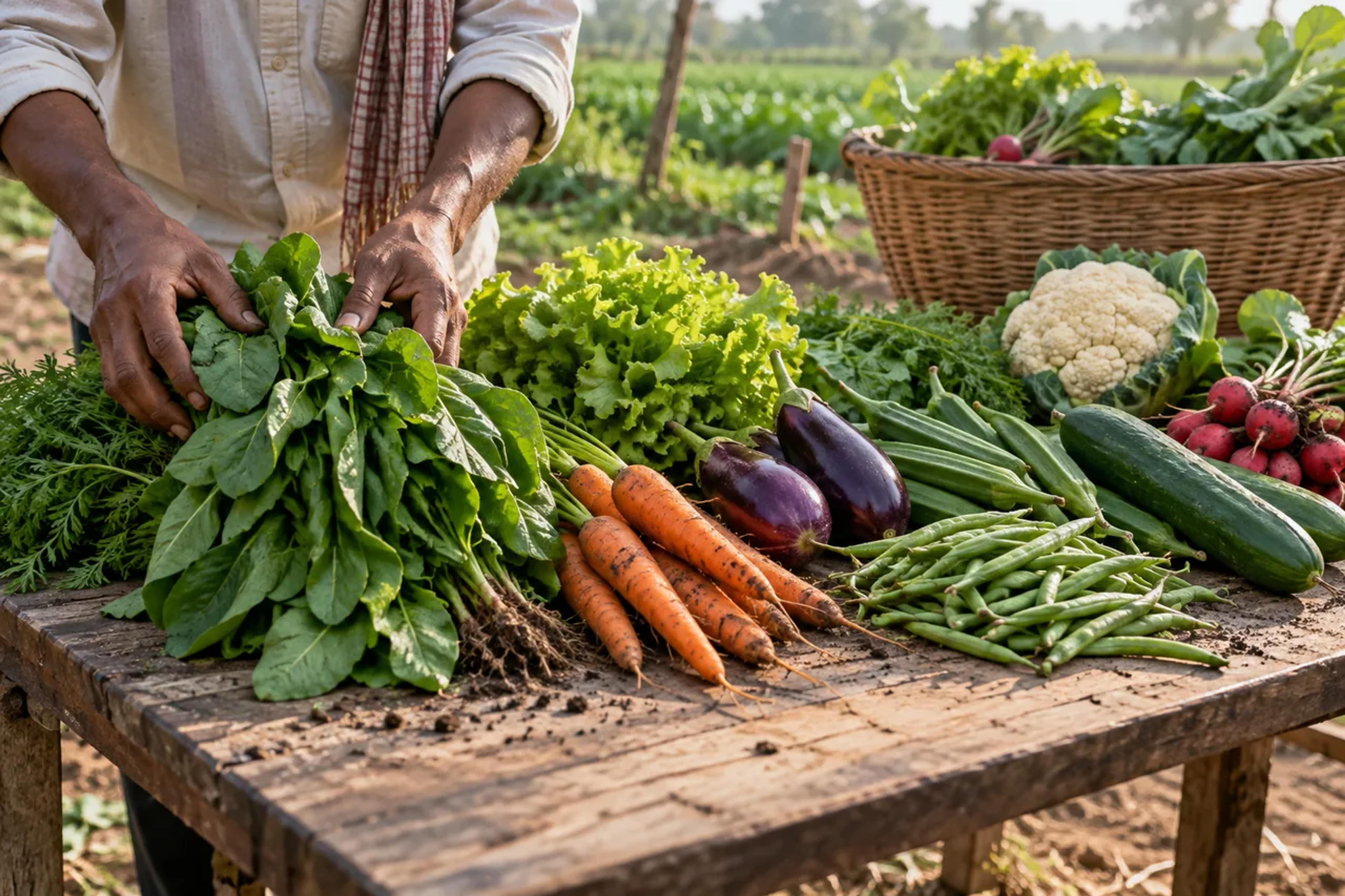
Grown with love. Never left alone.

You are not renting a patch of land. Real plants on our farm outside Delhi become yours. Each one is named, tagged, and watched every hour of every day. Nothing goes into the soil around them that we will not show you, no harvest ships before an outside lab has screened it, and every bag says which plant it came from.

Meet your plantsJoin the waitlistDelivered weekly, or twice a week, across Gurgaon and South Delhi.
Rows of vegetables growing under cover at the farm
Ladybaby 12, in bed C412 min agolast time somebody checked on it
Cut by hand

Someone walks to your plants and cuts them. Nothing is machine-harvested.

Watched every hour

Cameras, soil probes and an agent that never looks away.

Every plant named

You will know which plant fed you. Supermarket greens are three to five days old, and anonymous.

Lab tested first

No harvest leaves the farm until an outside lab has screened it. You get the lab, the batch and the date.

How it works

Four steps, and only two of them are yours.

You choose what you want to eat, and you eat it. Everything between those two is somebody else’s job, which is the entire point.

Pick what you want to eat
1

Pick what you want to eat

From the crops growing on the farm this week. You are choosing a living plant, not a seed packet.

Assigned in minutes
Meet your plants
2

Meet your plants

Specific plants in those beds become yours. Each one gets a name, a tag in the soil and a record of its own.

Yours from day one
We look after them
3

We look after them

Cameras, soil probes and an agent that never looks away. Water, feed and shade move when a plant needs them, not on a timer.

Checked every hour
They come to you
4

They come to you

Cut by hand, cooled at the farm, and batched with the rest of your plants.

Weekly or twice a week
Your plants

Thirty-two plants. Thirty-two names.

A palak planting runs about thirty-two plants at 20 cm rows, and every one of them is yours. Each gets a name, a tag in the soil, a dated photograph every day and a health score of its own, so when a bag arrives you can say which plant fed you.

  • A named tag beside every plant, legible in your own photo.
  • Per-plant health, growth stage and days to the next cut.
  • Soil moisture and temperature from a probe in that bed.
  • Every automated action, with the reading that caused it.
A vegetable bed seen from above with young plants spaced in rows 32 plants · all named
How they are looked after

Love does not scale. Attention does.

Food cooked with love tastes better because somebody paid attention. Tasted it, adjusted it, cared whether you liked it. Plants are no different. A plant that is watched gets water before it wilts, feed before it yellows and shade before it burns. We cannot give thirty thousand plants a gardener each, so we gave them something that never looks away, and a farm team that acts the moment it speaks up.

The canopy holds off the sun, the probe reads the soil, and a scan passes over every plant on a loop. None of it waits to be asked.

What is actually yours

Water and feed are dosed to a whole bed, and the shade net runs across an entire bay. That is how competent field agronomy works, and we are not going to draw you a valve that does not exist. What is yours is not the soil. It is the plants standing in it: which ones, what they are called, their daily health record, when they get cut, and the weight in your bag.

Yesterday, bed C4

A real day, on real plants.

Every line names what tripped, what the system did, and what happened next.

Bed C4 · Palak · day 27 of 35
06:12Tension 38 kPa, past threshold. Drip zone 3 on, 1.4 L over 11 min. Bed came back to 27.4% VWC.
06:41Fertigation: 0.9 g CAN, 0.4 g MKP. Feed EC 1.6 dS/m, pH pulled 7.4 to 6.6.
10:02Whitefly at 6 per trap per 24 h. Under the action threshold of 10. Monitoring, no spray.
12:55Stage advance, day 27. Palak is now in rapid leaf expansion. First cut estimated 9 days out.
13:30Irrigation lockout. 12 mm forecast by 18:00. Three scheduled events deferred.
15:47Scouted by hand by Rekha, farm team. Leaf-miner trails on Ladybaby 12 and Ladybaby 19. Both leaves removed, neem at 3 ml/L.
From members

People who pay for this, on why.

The first three did not talk about the vegetables at all. The rest did.

I did not expect to care about a vegetable. My daughter checks on Sunny 4 before she checks her phone.
Meghna R.Sector 54, Gurgaon · Member since March
The bag turned up with names printed on it. I assumed it was a gimmick until I drove out and found the tags actually in the soil.
Arjun T.Nizamuddin East · Member since January
It does not feed us. It feeds one dinner a week, and I know exactly what went into it, which is the part I was paying for.
Farida S.Golf Course Road · Member since November
The palak does not go limp on day two the way the packet stuff does. That was the first thing I noticed, well before any of the app.
Kavita M.DLF Phase 4 · Member since February
I have stopped washing it three times. There is a lab report telling me what is not on it, which is more than my sabziwala has ever offered.
Rohit B.Vasant Kunj · Member since April
Bhindi that is not slimy. I did not know that was something you could just buy.
Priyanka D.Sushant Lok · Member since December
Paperwork

What we hold, and what we do not.

A farm that only lists the certificates it has passed is telling you half of something.

Food safety

FSSAI licence

1XXXXXXXXXXXX

Every batch leaves under a licensed food business operator.

Residue testing

NABL-accredited lab

Every harvest, before it ships

A lab we do not own screens every harvest before it leaves the farm. You get the lab, the batch and the date. Testing is destructive, so it is the batch that is tested, never the plant you are sent.

Organic

NPOP / India Organic

Application in progress

We are not certified yet, so we do not use the word. Until then the lab report is the claim.

Price

Your plants. Everything they need, included.

Billed monthly. Growing, feeding, pest management and delivery are all in the number, so there is nothing else to buy.

₹1,499per month

₹50 a day. Less than one coffee at Galleria.

  • Your own named plants, tagged and photographed every day.
  • Growing, feeding and pest management included.
  • Weekly or twice-weekly delivery, cut by hand at the farm.
  • Outside lab screening on every harvest before it leaves.
  • A plant that dies is replaced free; a failed planting credits the month.
  • Stop after any harvest, from the app, without a phone call.
Meet your plants

What actually arrives

Palak, per cut60–90 g
Palak, cuts per season4–6
Bhindi, per pick120–200 g
Carrot, one lift at day 90–110350–600 g
A typical month1–2 kg

These are real numbers off a planting this size, not a best case. It is two or three dinners of greens a month, and it is why we say this sits beside your vegetable shopping rather than replacing it.

Verification

Four ways to catch us lying.

Two organic subscriptions in this city have already sold you mandi produce in kraft paper. You should assume we are doing the same until you can check.

1

Their names are in the frame

Every plant of yours carries a tag with its name pushed into the soil beside it, and those tags show in your daily photo. The same names are printed on the bag. If they do not match, you have caught us.

2

Come without telling us

Any working day, no appointment, no tour guide. Walk to your own plants and cut them yourself. Forty minutes from Golf Course Road.

3

Tested by someone who is not us

Residue screening on delivered batches at an outside NABL-accredited lab. You get the lab's name, the batch and the date.

4

You will hear about the bad days

A feed reporting only good news for ninety days is a screensaver. Pest pressure, failed germination, plants that died and missed deliveries all show up in your log.

The awkward questions

Asked in good faith, answered the same way.

If an answer here sounds like marketing, tell us and we will rewrite it. Most of these came from people who did not sign up.

₹1,499 a month for ₹150 of vegetables. Why would anyone do that?+

On a per-kilo basis this will never beat the mandi, and we will not pretend otherwise. Today ₹40 buys you a bunch of palak and an unanswerable question about what was sprayed on it, and when.

What ₹1,499 buys is a set of named plants, a dated photo of them every day, a full record of what went into the soil around them, and a harvest cut by hand rather than pulled off a shelf. If you want cheap vegetables, keep your sabziwala. Most of our members do exactly that.

An AI looking after my plants. Isn't that the opposite of love?+

Love is attention. Attention at three in the morning, on thirty thousand plants at once, is the one thing software is genuinely good at and people are genuinely bad at.

The agent does not care about your palak. It simply never stops looking at it, and it wakes Rekha the moment something is wrong. Rekha cares. That division of labour is why a plant of yours gets checked while you are asleep, and it is the only honest way we know to do this at more than village scale.

How do I know these are really my plants?+

Each of your plants has a tag pushed into the soil beside it carrying its name, and those tags are legible in your own daily photo. The same names are printed on the bag that arrives.

Come and stand in front of them any working day without telling us first. We would rather you verify it than believe us.

If the bed is shared, in what sense are the plants mine?+

Irrigation is dosed to a whole bed and the shade net runs across an entire bay. Anyone claiming to run a valve for your plants alone is describing equipment they do not own.

What is yours is not the soil. It is the plants standing in it: which ones, what they are called, the tag beside each, their daily photo and health record, when they are cut, and the weight in your bag. You are buying plants, not land.

What happens when one of my plants dies?+

You hear it from us, by name, with what went wrong and what we tried. We would rather tell you Ladybaby 12 did not make it than quietly swap it out and hope you were not looking.

A new plant goes in at our cost and gets a name of its own. If a whole planting fails we replant and credit the month. Agricultural risk is ours, not yours.

What about the four months when Delhi grows almost nothing?+

May and June are brutal, and the monsoon brings fungal pressure and waterlogging. You shift to what actually grows, like bhindi, chaulai and lauki, and the yield is smaller and more honest.

You can also pause for those months at a reduced rate. Your plants are cleared, and nothing is harvested or billed until you start again.

Can I cancel?+

After any harvest, from the app, without talking to anybody. If you cancel mid-cycle the default is that your subscription ends after your final cut, so you keep what you have already paid to grow.

Rows of plants under cover, each on its own drip line

Thirty thousand plants. Every one of them named.

Gurgaon and South Delhi first, because looking after plants this closely only works where we are dense. Outside that, join the list and we will come to your pin code.

Meet your plants
Waitlist

We are not open yet. Tell us to come to you.

Gurgaon and South Delhi first. Leave your number and we will message you once, when there are plants free in your area — then, if you have two minutes, tell us what you would actually want from this. The second part is optional and it shapes what we plant.

Tell us where to find you.

Three fields. We will message you once, when we open in your area, and there is no newsletter behind this.

+91
Where do you live?
Then nine optional questions, if you have two minutes.